Table of Contents
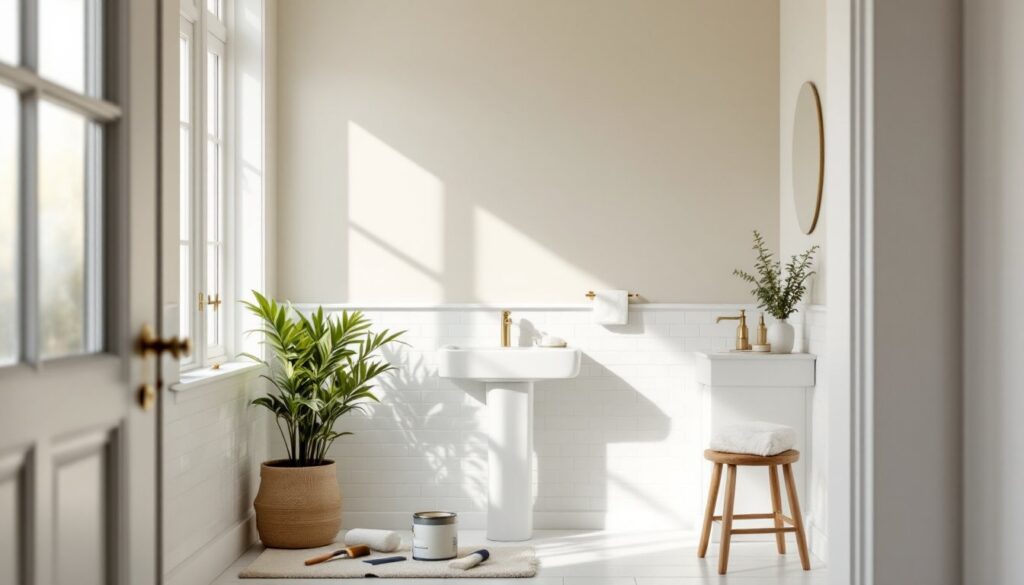
ToggleChoosing the right paint color for a small bathroom isn’t just about aesthetics, it’s about working with the physics of light, space perception, and moisture resistance. In 2024, the trend away from stark whites has opened up options for homeowners willing to make bolder choices in compact spaces. Whether dealing with a 5×8 powder room or a narrow full bath, the paint color sets the tone for everything else. This guide covers trending palettes for 2024, selection criteria based on lighting and fixtures, and practical painting tips specific to the challenges of small, high-humidity spaces.
Key Takeaways
- Small bathroom paint colors in 2024 trend toward warm whites, soft greiges, and bold jewel tones instead of stark whites, allowing homeowners to make more personalized design choices.
- Light reflectance value (LRV) and moisture-resistant formulas are critical for small bathrooms—opt for satin or semi-gloss finishes with mildewcide additives to prevent mold and ensure durability in high-humidity spaces.
- Test paint samples on multiple walls under different lighting conditions before committing, as the same color renders differently depending on natural light, fixture temperature, and time of day.
- Bold colors like navy, deep teal, and charcoal can work beautifully in small bathrooms when paired with white trim, quality lighting, and large mirrors to reflect light and prevent a cramped feel.
- Proper surface preparation—including thorough cleaning, mold treatment, caulk removal, and priming—combined with two coats of quality paint ensures a professional, long-lasting finish in moisture-prone bathroom environments.
Why Paint Color Matters More in Small Bathrooms
In a small bathroom, every surface is visible at once. There’s no hallway transition or furniture to break up wall color, so the paint choice has an outsized impact on how the space feels. Light colors can make a 40-square-foot bathroom feel open, while darker hues, applied correctly, add depth and hide the fact that the walls are close together.
Light reflectance value (LRV) matters here. Paints with an LRV above 50 reflect more light, which helps in windowless or poorly lit bathrooms. Paints below 50 absorb light, creating coziness but requiring good artificial lighting to avoid a cave effect. Test samples on all four walls, since a north-facing bathroom will render color differently than one with a skylight.
Moisture is the other factor. Small bathrooms often lack adequate ventilation, leading to higher humidity and potential mold growth. Use a bathroom-specific paint with mildewcide additives and a satin or semi-gloss finish. These finishes are wipeable and resist moisture better than flat or eggshell. Brands like Benjamin Moore’s Aura Bath & Spa or Sherwin-Williams’ Emerald are formulated for high-humidity environments and worth the upcharge in a space this prone to moisture.
Finally, small bathrooms often have busy visual elements, tile borders, patterned flooring, mirrors, and fixtures. The wall color either competes with or calms that visual noise. A cohesive palette pulls the room together: a mismatched one makes it feel chaotic.
Top Small Bathroom Paint Color Trends for 2024
Soft Neutrals and Warm Whites
The all-white bathroom is still around, but 2024 leans toward warm whites and creamy neutrals instead of stark, cold tones. Colors like Benjamin Moore’s Swiss Coffee (OC-45) or Sherwin-Williams’ Alabaster (SW 7008) bring warmth without reading as beige. These shades have subtle yellow or pink undertones that soften artificial lighting and pair well with chrome, brass, or matte black fixtures.
Greige, a gray-beige hybrid, remains popular for small bathrooms because it’s neutral enough to work with various tile colors but has more character than pure gray. Sherwin-Williams’ Accessible Beige (SW 7036) and Behr’s Silver Drop (PPU18-14) are go-to choices. Greige works especially well when the bathroom has white subway tile or marble: it provides contrast without clashing.
Another trending neutral is soft sage or muted green-gray, which brings an earthy, spa-like quality. Farrow & Ball’s Pigeon or Benjamin Moore’s Healing Aloe (1562) add subtle color while maintaining the light-reflective qualities needed in a small space. These tones pair naturally with wood vanities and brushed nickel hardware.
Bold Jewel Tones and Moody Hues
Contrary to old advice, dark colors can work beautifully in small bathrooms, if the lighting is right. Deep blues, charcoal, and rich greens are trending in 2024, especially in powder rooms and bathrooms with good natural light or high-quality LED fixtures.
Navy and deep teal create a jewel-box effect. Sherwin-Williams’ Naval (SW 6244) and Benjamin Moore’s Hale Navy (HC-154) are popular choices that feel sophisticated rather than oppressive. These work best in bathrooms with white trim, brass fixtures, and a large mirror to bounce light around. According to designer-approved bathroom palettes, pairing bold wall color with crisp white ceilings and trim prevents the space from feeling closed in.
Charcoal and deep gray are also gaining traction. Benjamin Moore’s Kendall Charcoal (HC-166) or Sherwin-Williams’ Peppercorn (SW 7674) add drama without the commitment of black. These shades work well in modern or industrial-style bathrooms with concrete-look tile or matte black fixtures. The key is to use a semi-gloss finish to keep the walls from absorbing all the light.
For those wanting color without full commitment, an accent wall in a bold hue, behind the vanity or in a shower niche, adds interest while keeping the overall space bright. Consider terracotta, dusty rose, or even a muted mustard for a 2024-appropriate pop of warmth.
How to Choose the Right Paint Color for Your Small Bathroom
Start by assessing the bathroom’s natural and artificial lighting. A bathroom with a window can handle darker colors: a windowless one needs higher LRV paints to avoid feeling like a closet. Check the color temperature of the light bulbs, warm white (2700K-3000K) makes creams and beiges look good, while daylight bulbs (5000K+) favor cooler grays and blues.
Next, consider existing fixtures and finishes. If replacing tile, vanity, and hardware isn’t in the budget, the paint has to work with what’s there. Almond or bone-colored fixtures (common in older homes) look best with warm neutrals or soft greiges, not cool grays. White or black fixtures are more flexible and pair with nearly any color.
Test paint samples on at least two walls, one that gets direct light and one that doesn’t. Paint a 2×2-foot square and live with it for a few days, checking how it looks in morning, afternoon, and evening light. This step is non-negotiable: paint colors shift dramatically depending on lighting and adjacent surfaces.
Think about the mood and function. A powder room used only by guests can handle bolder color or pattern (consider a dark, moody shade or even wallpaper on one wall). A family bathroom used for morning routines benefits from energizing but not jarring colors, soft blues, warm whites, or pale greens. Browse home design platforms for real-world examples of how colors perform in spaces similar in size and layout.
Finally, factor in ceiling color. In small bathrooms, painting the ceiling the same color as the walls can blur boundaries and make the room feel larger. Alternatively, a lighter ceiling (or classic white) maintains a sense of height. If the bathroom has low ceilings (under 8 feet), keep the ceiling light to avoid a compressed feeling.
Expert Tips for Painting Small Bathrooms
Prep is everything in a bathroom. Moisture, soap residue, and old caulk all interfere with paint adhesion. Start by removing switch plates, towel bars, and toilet paper holders. If there’s a pedestal sink or tight vanity, painting around it is possible but tedious, consider whether it’s worth removing the sink temporarily for better access.
Clean walls thoroughly with a degreasing cleaner (TSP substitute works well) and rinse. Let dry completely. Fill any holes or dents with lightweight spackle, sand smooth with 120-grit sandpaper, and prime those spots. If the walls have any mildew, treat with a bleach solution (1 part bleach to 3 parts water), rinse, and let dry fully before painting.
Prime the entire room if painting over a dark color, switching from oil to latex paint, or if the walls haven’t been painted in several years. Use a stain-blocking primer like Zinsser B-I-N or Kilz Premium if there’s any water staining or if covering bold wallpaper.
Remove old caulk around the tub, shower, and sink before painting. Paint won’t adhere to silicone caulk, and you’ll get a cleaner result re-caulking after the walls are done. Use a utility knife and caulk removal tool, then clean the joint with rubbing alcohol.
For application, use a 4-inch roller and angled brush for cutting in. Small bathrooms have lots of corners, edges, and trim, so a quality 2.5-inch angled brush (Purdy or Wooster) makes a difference. Roll in a “W” pattern to avoid lap marks, and work in sections, don’t try to paint the whole room at once and then go back.
Ventilation is critical. Run the exhaust fan during and after painting, and crack a window if possible. Moisture-resistant paint still needs airflow to cure properly. For remodel inspiration and detailed project guides, check resources on bathroom design platforms.
Apply two coats minimum, even if the paint claims one-coat coverage. In a bathroom, durability and washability come from proper build. Let the first coat dry fully (check the can, usually 2-4 hours) before applying the second. Wait 24 hours before re-installing hardware, and avoid heavy moisture (long showers, baths) for 48 hours to let the paint cure.
Finish by re-caulking the tub, shower, and sink with 100% silicone caulk in white or clear. Tool the bead with a wet finger or caulk tool for a clean line. This step prevents water infiltration and gives a polished look.
Conclusion
Paint is the most cost-effective way to transform a small bathroom, but the right choice depends on lighting, existing finishes, and intended mood. In 2024, the palette has expanded beyond safe whites to include warm neutrals, soft greiges, and even bold jewel tones when applied thoughtfully. Proper surface prep, moisture-resistant formulas, and adequate ventilation ensure the finish lasts. Test samples in the actual space, invest in quality paint and primer, and don’t skip the re-caulking step for a professional result.