Table of Contents
ToggleYour home’s electrical panel has been doing the same job for decades, flipping breakers when circuits overload and routing power to outlets and fixtures. But in 2026, a new generation of smart electrical panels is changing that dynamic entirely. These intelligent control hubs combine traditional circuit protection with real-time energy monitoring, remote management, and automation capabilities that give homeowners unprecedented control over their electrical systems. Whether you’re building new, renovating, or just tired of stumbling to the basement during an outage, understanding smart panels is worth your time.
Key Takeaways
- Smart panels for home electrical systems combine traditional circuit protection with real-time energy monitoring, remote management, and automation—giving homeowners unprecedented control over power consumption and distribution.
- Per-circuit energy monitoring in smart panels helps identify energy-wasting appliances and can save hundreds of dollars annually by revealing consumption patterns and enabling optimization for time-of-use rate plans.
- Smart panel installation requires a licensed electrician and local permits due to safety hazards and NEC code compliance; DIY attempts are dangerous and can void homeowner’s insurance.
- Smart panels integrate with voice assistants and home automation systems, enabling automation rules like scheduled circuit control and geofencing to reduce energy waste and improve home convenience.
- While smart panels cost $3,500–$7,000 installed (versus $650–$1,900 for traditional panels), they future-proof homes for solar arrays, battery storage, EV chargers, and emerging technologies like vehicle-to-home charging.
- Traditional circuit breakers are purely mechanical with zero connectivity, whereas smart panels add digital control layers that enable remote switching, real-time alerts, and integration into broader smart home workflows.
What Is a Smart Panel and How Does It Work?
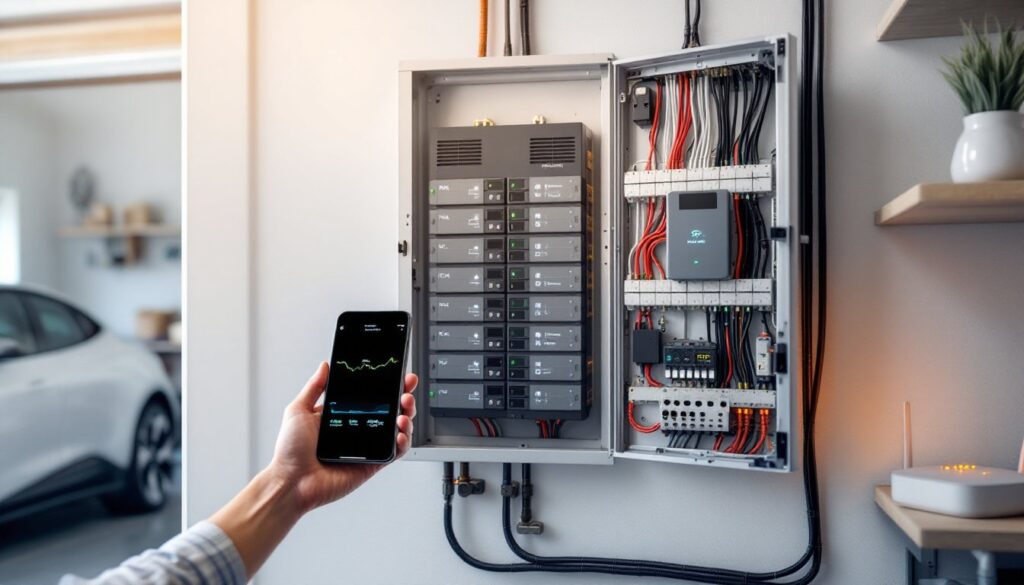
A smart electrical panel replaces or augments your traditional circuit breaker box with digitally controlled circuit breakers and built-in connectivity. Instead of mechanical toggle switches, each circuit has a smart breaker that communicates with a central hub or controller.
These panels connect to your home Wi-Fi network, allowing you to monitor and control individual circuits from a smartphone app. When a circuit draws power, the panel tracks energy consumption in real time and reports it back to the app. You can see exactly how much electricity your HVAC system, kitchen appliances, or garage workshop consumes, down to the watt.
Most smart panels use solid-state breakers or hybrid designs that combine traditional thermal-magnetic trip mechanisms with digital control layers. When you flip a circuit off in the app, the panel physically disconnects power to that circuit, just like manually flipping a breaker. The difference is you can do it from anywhere.
Some systems integrate with voice assistants and smart home dashboards, enabling automation rules like “turn off the garage outlets at 10 PM” or “disable the water heater during peak rate hours.” The panel communicates via your router, and most require a neutral wire connection at the panel location (standard in homes built after the 1980s).
Key Benefits of Upgrading to a Smart Electrical Panel
Energy visibility is the biggest draw. Traditional panels hide consumption behind a dumb metal door. Smart panels surface detailed usage data, letting you spot energy hogs and adjust habits. Many homeowners discover that a second refrigerator in the garage or an old pool pump wastes hundreds of dollars per year.
Remote control means you can kill power to forgotten appliances, disable circuits before vacation, or troubleshoot tripped breakers without a flashlight and a trip to the basement. If a breaker trips while you’re away, you’ll get a push notification and can often reset it remotely (assuming the trip wasn’t caused by a dangerous fault).
Load management helps homes with solar arrays, battery storage, or EV chargers avoid overloading the main service. Smart panels can prioritize critical loads during an outage or shift heavy draws (like car charging) to off-peak hours when electricity rates are lower. This is especially useful for homes on time-of-use rate plans.
Safety upgrades include arc-fault and ground-fault detection built into individual smart breakers, offering better protection than older panels. Some models can detect overheating conditions and send alerts before a fire risk develops.
Finally, smart panels simplify future expansion. Adding a new circuit often means configuring it in software rather than hiring an electrician to rewire the panel, though you’ll still need a licensed pro to run the wire and terminate connections per National Electrical Code (NEC) standards.
Top Smart Panel Features to Look For
Energy Monitoring and Usage Insights
Look for panels that offer per-circuit monitoring rather than whole-home tracking. Per-circuit data lets you pinpoint exactly which loads are drawing power and when. The best systems display historical trends, compare usage month-over-month, and estimate costs based on your utility rate.
Some panels integrate with third-party energy platforms or export data to CSV files for deeper analysis. This matters if you’re managing a home with solar panels, a battery system, or time-of-use billing. Real-time alerts for unusual consumption (like a sump pump running continuously) can prevent damage and save money.
Panels with machine learning can identify specific appliances by their electrical signatures and auto-label circuits, helpful if the previous owner left cryptic labels like “Kitchen 2” and “Misc.”
Remote Control and Circuit Management
Remote circuit control is standard, but implementation varies. Some panels let you schedule circuits to turn on or off at specific times, useful for holiday lighting, aquarium pumps, or dehumidifiers. Others support geofencing, automatically disabling non-essential circuits when everyone leaves home.
Check whether the app allows multiple user access with permission levels. You might want a family member to monitor usage but not disable the refrigerator circuit by accident.
Integration with ecosystems like Amazon smart home devices or Google Home adds voice control and automation triggers. For example, “Alexa, turn off the basement outlets” becomes possible when the panel supports these platforms. Many smart light switches pair well with smart panels for whole-home lighting control.
Backup power integration is a premium feature. Panels with automatic transfer switches can prioritize circuits during a grid outage if you have a generator or battery backup, shifting power to essentials like the fridge, furnace, and a few outlets.
Smart Panel vs. Traditional Circuit Breaker: What’s the Difference?
A traditional panel is purely mechanical. Breakers trip when current exceeds rated capacity or when a fault occurs, but they don’t communicate, measure, or respond to external commands. Resetting a breaker means physically flipping a switch. You get zero insight into energy use unless you install separate monitoring hardware.
Smart panels add a digital control layer. Every circuit becomes a data point and a controllable endpoint. Breakers can be switched remotely, scheduled, or automated based on conditions. You gain visibility into consumption patterns, receive alerts for faults, and integrate electrical control into broader home automation workflows.
Cost is the trade-off. Traditional panels run $150–$400 for the panel and breakers: installation by a licensed electrician costs $500–$1,500 depending on service size and local rates. Smart panels start around $2,500–$4,000 for the hardware alone, with installation adding another $1,000–$3,000. High-end models with battery integration or advanced load management can exceed $6,000.
Another difference: maintenance and software updates. Smart panels require firmware updates and rely on cloud services or local network connectivity. If the manufacturer discontinues support, features may degrade over time. Traditional panels have no such dependency, they work the same in 2026 as they did in 1996.
Permit requirements are identical for both. Any panel replacement or service upgrade must comply with local building codes, typically based on the NEC and enforced by your jurisdiction’s authority having jurisdiction (AHJ). Inspections are mandatory.
Installation Considerations: DIY or Professional?
Do not attempt to install a smart panel yourself unless you’re a licensed electrician. This is not a DIY project. Working inside a live electrical panel exposes you to lethal voltage, 240V split-phase service in most U.S. homes. Even with the main breaker off, utility-side conductors remain energized until the utility company disconnects service at the meter.
Permits are required in virtually all jurisdictions for panel replacement or upgrade work. Inspectors verify proper grounding, bonding, wire sizing, and compliance with NEC Article 408 (panelboard requirements) and Article 310 (conductor ampacity). Unpermitted electrical work can void homeowner’s insurance, complicate home sales, and create serious safety hazards.
Smart panels also require network connectivity, which means running Ethernet or ensuring strong Wi-Fi coverage near the panel location, often a basement, garage, or utility room with poor signal. Some installers recommend a dedicated access point or powerline adapter to maintain reliable communication.
If you’re upgrading from a 100-amp to 200-amp service to support new loads (EV charger, heat pump, electric range), the utility company must install a new meter base and possibly upgrade the service drop. This adds weeks to the timeline and $1,000–$3,000 in utility fees, separate from the panel cost.
Plan for a full-day installation minimum. The electrician will de-energize the home, pull the old panel, mount the new enclosure, terminate all branch circuits, install smart breakers, configure the system, and restore power. Factor in an electrical inspection before the system goes live.
Some smart panel manufacturers offer retrofit kits that install smart breakers into existing panel enclosures, avoiding a full swap. These cost less ($1,000–$2,000 installed) but may not fit all panel brands or offer the full feature set of a dedicated smart panel. Compatibility varies, so consult a licensed electrician familiar with the specific product.
For homes with modern electrical systems and basic automation goals, a smart panel is a worthwhile long-term investment, especially if paired with solar, battery storage, or smart home enhancements. But if your panel is outdated, lacks adequate circuits, or still uses fuses, prioritize code-compliant electrical infrastructure before adding smart features. Safety and reliability come first.
Finally, consider future-proofing. Many regions are moving toward electrification mandates and renewable energy incentives. A smart panel positions your home to manage distributed energy resources, participate in utility demand-response programs, and support emerging technologies like vehicle-to-home (V2H) bidirectional EV charging. It’s an investment in flexibility as much as convenience.